
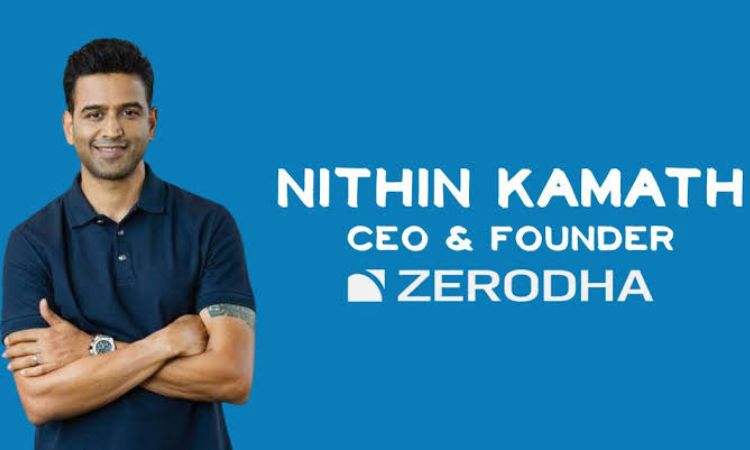
The Self-Taught Trader
Nithin Kamath dropped out of college at 17 to learn stock markets by doing: putting real money in and watching what happened. He spent a decade becoming exceptionally good at trading — while working as a sub-broker and call centre employee to fund his positions.
He wasn't born into a family with capital or connections. He was a self-taught, self-funded market practitioner who understood, at a granular level, exactly how the Indian brokerage system was extracting value from small investors — through opaque percentage commissions, poor execution infrastructure, and interfaces designed to discourage rather than enable.
By 2010, he had identified the structural problem in Indian broking with the precision of someone who had lived it for ten years. He co-founded Zerodha with his brother Nikhil to fix exactly that. The name itself — Zerodha, a portmanteau of 'zero' and 'rodha' (barrier in Sanskrit) — was the product thesis: remove every barrier between the Indian investor and the market.
₹20 Flat. Zero VC.
Zerodha introduced flat-fee brokerage to India: ₹20 per trade regardless of order size (and ₹0 for equity delivery), at a time when brokers charged 0.5%-1% of trade value. This single pricing decision democratised investing for millions priced out by the old model.
A retail investor trading ₹5 lakh would have paid ₹2,500-5,000 to a traditional broker. With Zerodha: ₹20. The math was obvious. The incumbents couldn't match it without cannibalising their own business models. Zerodha had no such legacy cost structure to protect.
Kite — their trading platform — launched and quickly became the benchmark for every Indian fintech. Clean. Fast. Honest. No dark patterns. No upsell. Just a well-designed interface that let investors do what they came to do. In a sector addicted to complexity, simplicity became Zerodha's most powerful competitive moat.
And throughout this entire process — not a single rupee raised from venture capital.
The Bootstrapped Billionaire
Today, Zerodha has 1.5 crore active customers and an $8.2B valuation. Nithin also built Varsity (free financial education, 10M+ users), Rainmatter (a fintech incubator backing 40+ startups including Smallcase, Sensibull, and Ditto Insurance), and has become India's most respected voice on sustainable investing and responsible capital allocation.
The Zerodha story is the definitive antidote to the idea that fundraising equals success. Every Indian fintech that followed — CRED, Groww, INDmoney — has had to answer the Zerodha question: why do you need external capital, and what does it cost you to have it?
Nithin Kamath's answer has always been the same: if your business is genuinely useful, the capital comes from the customers. Everything else is just a story founders tell to justify giving away equity they didn't need to give away.
Fifteen years. ₹0 VC. $8.2B. 1.5 crore investors. The math is simple — and it's the most important lesson in Indian startup history.